

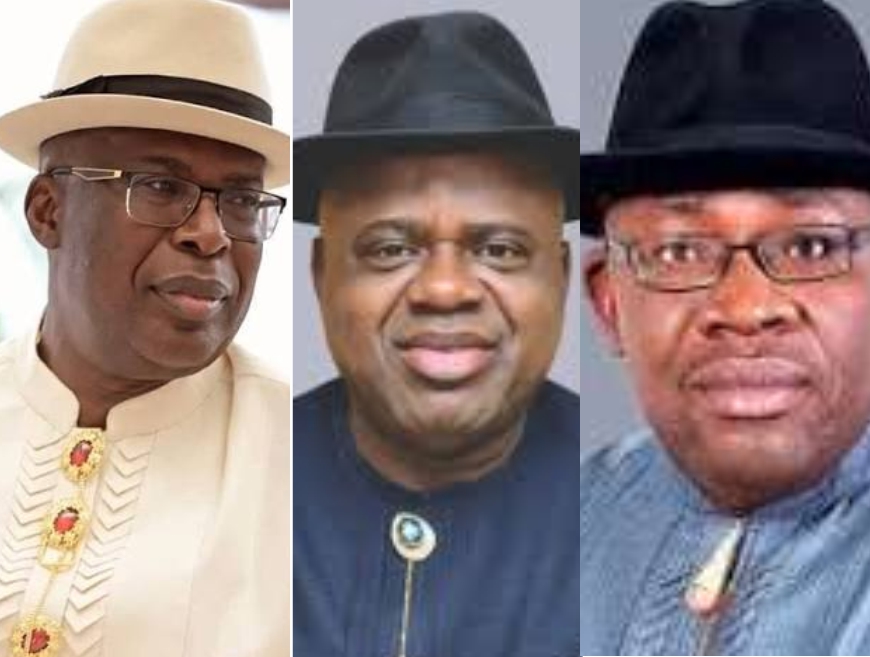

The resignation of former Governor of Bayelsa State and former Minister of State for Petroleum Resources, Chief Timipre Sylva, from the All Progressives Congress (APC) may have opened a new chapter in the political calculations ahead of the 2027 general elections in the oil-rich state.
Sylva, a prominent founding member of the APC in Bayelsa and one of the state’s most influential political figures, announced his resignation from the party in a letter addressed to the APC chairman of Ward 4 in Brass Local Government Area.
In the letter, Sylva reportedly expressed dissatisfaction with what he described as the unfair treatment of founding members of the party, accusing the APC leadership of departing from the principles and ideals upon which the party was established.
He also criticised the activities of the Economic and Financial Crimes Commission (EFCC), alleging that the anti-graft agency had become an appendage of the ruling party rather than functioning as an independent institution of state. The allegations remain claims by the former governor and have not been independently established.
Sylva’s resignation has come at a politically sensitive period when political parties and major political actors in Bayelsa are already positioning themselves for the 2027 elections. His next political move has consequently become a subject of intense speculation across the state.
The former governor, who served as Bayelsa governor between 2007 and 2012 before becoming Minister of State for Petroleum Resources under the Muhammadu Buhari administration, has remained a major force in Bayelsa politics despite spending years outside Government House.
His political network extends across several local government areas, while his long-standing relationships with politicians, party leaders and grassroots supporters make his departure from the APC potentially significant for the party’s electoral calculations.
The biggest question now is where Sylva will pitch his political tent.
Although the former governor has not publicly announced his next political destination, speculation is already mounting that his exit from the APC could trigger further realignment among politicians associated with him.
One of his prominent political associates, his former running mate in the 2023 governorship election, Joshua Maciver, has already defected to the Peoples Democratic Party (PDP) and declared his intention to contest the governorship election in 2027.
Maciver’s movement has further fuelled speculation that Sylva’s political network could be heading for a major realignment, although there is no confirmation that all those associated with the former governor will follow the same political path.
The development could pose a challenge to the APC if Sylva’s resignation eventually leads to the movement of other influential party members and grassroots supporters.
Beyond the APC, however, the larger implication could be the emergence of a new coalition of political interests capable of reshaping the contest for power in Bayelsa.
One of the most intriguing possibilities being discussed in political circles is the prospect of Sylva working with former Governor Seriake Dickson and other opposition forces under the Nigeria Democratic Congress (NDC) ahead of the 2027 elections.
Such an alliance, if it materialises, could dramatically change the political equation in the state.
Dickson, who governed Bayelsa from 2012 to 2020, remains an influential figure in the state’s political landscape. Although the political histories of Sylva and Dickson have been marked by rivalry and differences, changing political circumstances could create room for previously unlikely alliances.
A political understanding between the two former governors would therefore be closely watched, particularly if it brings together their respective political networks in an attempt to challenge the existing political order in the state.
The potential impact would not be limited to the governorship election. A coordinated political alliance could seek to challenge the established political structures across the state’s three senatorial districts, five federal constituencies and the 24 State House of Assembly constituencies.
Such a development could make the 2027 elections significantly more competitive, especially if opposition parties and political groups are able to overcome the fragmentation that has often weakened their ability to challenge established structures.
Governor Douye Diri and the APC will be seeking to consolidate their hold on the state and defend the administration’s record before the electorate, while the APC will be looking to strengthen its presence and capitalise on its position at the federal level.
The emergence of another powerful political alignment could complicate those calculations.
For the APC in particular, Sylva’s departure could raise questions about how the party intends to manage its internal structure in Bayelsa. His political relevance means that the issue may not simply be about losing an individual party member, but about retaining the loyalty of politicians and supporters who identify with his political structure.
At the same time, Sylva’s departure does not automatically translate into an electoral advantage for any opposition party. Bayelsa politics is complex and heavily influenced by local political structures, personalities, community interests and the strength of candidates at the ward and local government levels.
The former governor’s eventual political destination will therefore be crucial.
He could join an existing opposition party, support another political platform, negotiate an alliance without formally joining a party, or pursue an entirely different political strategy. Each option could produce different consequences for the 2027 contest.
His legal battles could also remain part of the political conversation. Sylva has faced allegations in court which he has denied, and reports concerning his legal status and whereabouts have generated political discussion. However, claims about his present whereabouts or legal status should not be treated as established facts without authoritative confirmation.
What is clear is that his resignation has created a fresh political storyline in Bayelsa.
The state is already heading towards what promises to be a fiercely contested 2027 election, with the PDP, APC, NDC and other emerging political interests expected to mobilise across the eight local government areas.
The crucial question is whether Sylva’s resignation will remain an internal APC crisis or become the beginning of a wider political realignment.
If Sylva eventually reaches an understanding with Dickson and the Nigeria Democratic Congress, and such an arrangement succeeds in bringing together other influential political actors, the consequences could extend well beyond the APC.
It could alter the balance of political forces in Bayelsa, influence the selection and fortunes of candidates for the governorship and National Assembly elections, and turn several previously predictable constituencies into major political battlegrounds.
For now, however, the political class is waiting for Sylva’s next move.
Where he goes, who follows him and whether he chooses to work with existing opposition forces could ultimately determine how far-reaching the consequences of his resignation will be.
About Author

