

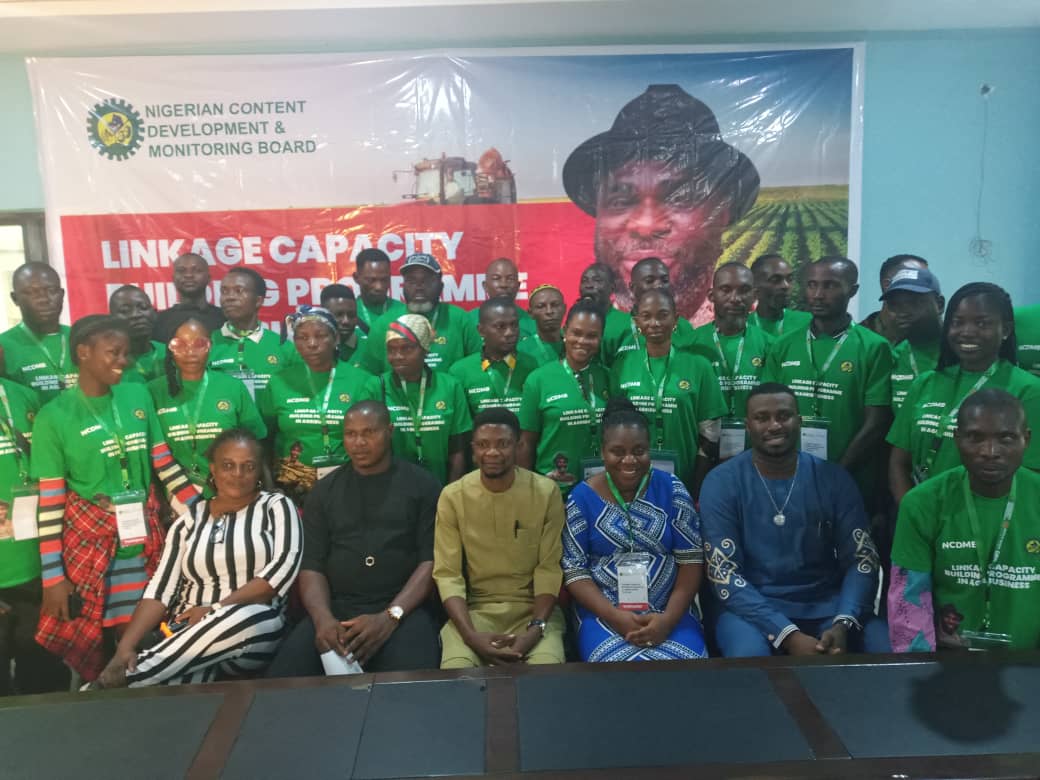

A major push to reposition agriculture as a driver of economic growth has begun in the Niger Delta region, as the Nigerian Content Development and Monitoring Board (NCDMB), in partnership with the Chairman of the Senate Committee on Local Content, Joel-Onowakpo Thomas, trained farmers and youths on hookup opportunities in agribusiness.
The Linkage Capacity Building Programme in Agribusiness, held in Oleh, Delta South Senatorial District, brought together farmers, consultants, development experts and community leaders.
The initiative, supported by NCDMB and technical partners including Eone Agri Products Limited, aims to connect local farmers to structured supply chains, improve productivity and reduce overdependence on oil revenue.
Represented by his Senior Special Adviser on Media, Publicity, Information and National Orientation, Paul Emumena Michael, Senator Thomas said the programme was designed to expand the concept of local content beyond oil and gas into agriculture.
He said Delta South is blessed with fertile soil and water resources but lacks the technical structure to turn farming into a profitable enterprise.
According to him, the training will equip participants with knowledge in processing, value addition, quality control and market linkage to help them scale beyond subsistence farming.
“Agribusiness today is not just about the hoe and machete; it is about data, processing, quality control and entrepreneurship. Our goal is to make Delta South the agricultural hub of the Niger Delta,” he said.
Speaking on behalf of the NCDMB Executive Secretary, Engr. Felix Ogbe, Franklin Agatemor said the programme was meant to reawaken interest in agriculture and correct the long-held belief that farming is only for the poor.
He noted that many people in the region had ignored the economic value chain in agriculture, focusing only on primary production without exploring processing and packaging opportunities.
“The knowledge itself is priceless. This training is something everyone should take seriously because it can change lives,” he said.
Programme Coordinator, Dr. Precious Itolima, representing Eone Agri Products Limited, said the initiative was designed to bridge the gap between traditional farming and modern agribusiness practices in the Niger Delta.
She explained that agriculture in many southern communities is still viewed as subsistence work, unlike in other regions where it is treated as a structured and profitable enterprise.
According to her, the training aims to reorient participants to see agriculture as a professional and technology-driven sector.
Dr. Itolima stressed that modern agriculture involves mechanization, data management, agritech solutions and structured financing, adding that banks are willing to fund farmers who operate professionally.
“Agriculture should be seen as a profitable business and a respected career. The South has the capacity to lead not just in Nigeria, but globally,” she said.
One of the facilitators, Dr. Chimenem Ukpatu, a Community and Rural Development Specialist, said the core objective of the training was to help farmers understand that agriculture is a business.
She emphasized the importance of value chain participation, explaining that farmers who attempt to handle everything alone often incur losses and urged participants to collaborate, process their produce and seek market opportunities beyond their immediate communities.
Ukpatu said while she was not privy to the organisers’ post-training plans, she encouraged farmers to return to their farms with renewed commitment and better business strategies.
Another facilitator at the training, Manna Freeman, Managing Director of DHB Greenery Farm in Bayelsa, focused on practical topics such as soil testing, irrigation systems and structured farm planning.
She stressed that many farmers operate without understanding their soil type or having a proper business framework, adding that successful farming requires technical knowledge, a committed team and sound financial management.
“Farming requires more than passion, it requires vision. There will be setbacks, but if you have a clear vision for your agribusiness, you will continue and build something sustainable,” she said.
For Kelvin Oghenero Ahomafo, a poultry and crop farmer from Isoko with over 15 years of experience, the training has already begun to address longstanding challenges.
Ahomafo, who cultivates habanero pepper and tomatoes in addition to poultry farming, said the lectures were practical and directly related to the problems he faces on his farm.
“From just the first few classes, I can already see solutions to some of my problems. I believe there will be a turnaround in my agribusiness,” he said.
A young graduate, Otagba Elo Cynthia, said she had little interest in agriculture before attending the programme but now sees it as a viable career path.
She admitted that like many young people, she previously viewed agriculture as an occupation for the poor, adding that after learning about value chains and business opportunities within the sector, her perception had changed.
Otagba encouraged other youths, especially young women, to consider agribusiness as a serious option.
“Everybody must eat. Agriculture has so much potential. I now want to venture into it because there is profit in it,” she said.
About Author

