

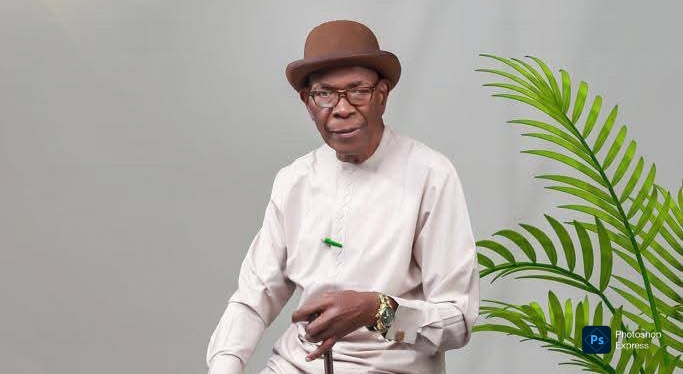
“Dancing on Graves”: 90-Year-Old Nigerian Scholar Prof. Gesiye Salo Angaye Condemns Elite Indifference Amid National Suffering

Renowned Nigerian economist and elder statesman, Professor Gesiye Salo Angaye, has issued a stark warning to the Nigerian political class, condemning what he described as a profound moral collapse amid widespread suffering.
In an article titled “Dancing on the Graves: Moral Collapse, Elite Indifference, and the Crisis of State Responsibility in Nigeria”, delivered as part of activities marking his 90th birthday, the Emeritus Professor of Developmental Economics accused the elite of celebrating and focusing on electoral ambitions while ordinary citizens grapple with insecurity, hunger, unemployment, and poverty.
Professor Angaye, a former Commissioner for Budget and Economic Planning in Bayelsa State and a native of Okoloba community in Kolokuma/Opokuma Local Government Area, lamented that Nigeria resembles “a nation at war with itself” — not through declared conflict, but via routine deaths from banditry, kidnapping, terrorism, and institutional neglect.
“While citizens bury their dead, political actors dance — literally and metaphorically — at rallies, celebrations, and defections,” he stated. “The contrast between elite comfort and popular misery reveals a deep moral fracture in the Nigerian polity.”
The nonagenarian scholar argued that the state has abdicated its core responsibility — the protection of life and property — leading to a breach of the social contract as envisioned by classical thinkers like Hobbes and Locke. He highlighted how vast territories remain unsafe, farms abandoned, schools closed, and citizens forced into self-help measures or silence.
“Hunger is not a natural disaster; it is a policy outcome,” Professor Angaye asserted. “A political class that remains festive amid mass hunger demonstrates institutionalized insensitivity — a condition where suffering no longer registers as a policy emergency.”
He expressed alarm over the growing fear among citizens, many of whom now self-censor to avoid arrest, harassment, or worse. “When people cannot speak, democracy becomes performative,” he noted. “Silence, in this context, is not consent; it is survival.”
The paper further criticized the early fixation on the 2027 elections amid ongoing crises, describing it as a “moral inversion” where winning power overshadows preserving life. Professor Angaye warned of “moral anomie” — a breakdown of shared values — where tragedies like mass killings and kidnappings no longer shock society, risking reproduction of injustice across generations.
Concluding on a note of hope and duty, the professor emphasized that speaking out against injustice is a civic and moral obligation. “Nigeria still has a choice: to restore compassion to governance, to re-center life as the supreme value of the state, and to rebuild trust between rulers and the ruled,” he wrote.
He ended with a poignant admonition: “Beware of dancing on graves which could collapse/give way to others to dance on your graves.”
Professor Angaye’s intervention, shared widely on social media and covered in national outlets, comes as he celebrated his 90th birthday, with tributes from figures including Bayelsa State Governor Senator Douye Diri, who attended the milestone event in Yenagoa. Known for his lifelong advocacy on good governance and sustainable development, the scholar continues to inspire through his writings and vocal critiques of national challenges.
About Author

