
 Francis Dufugha
By Francis Dufugha
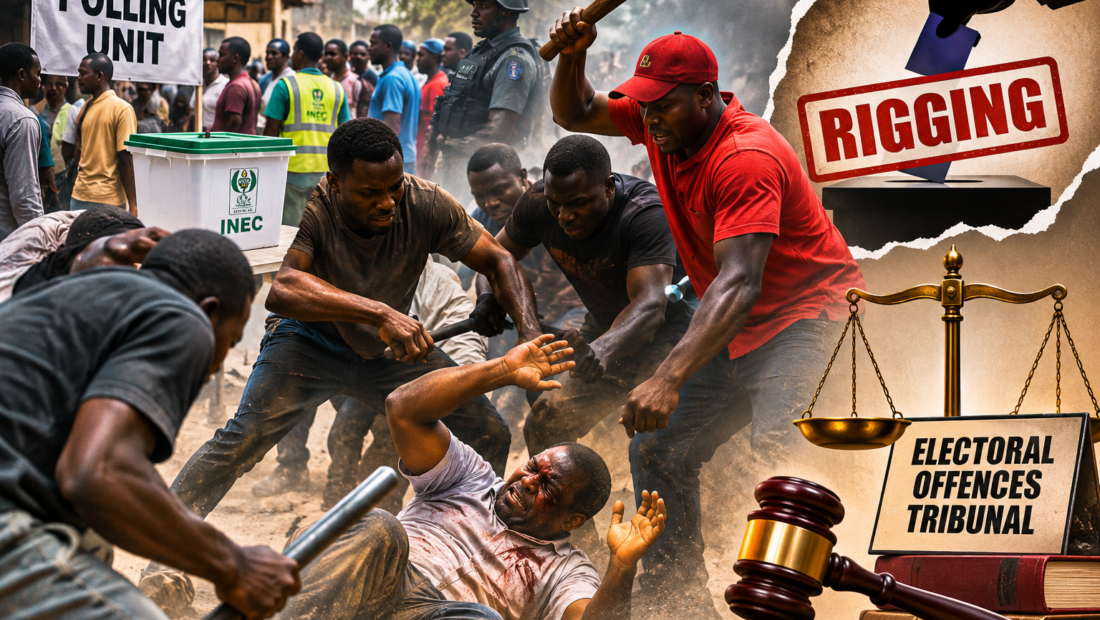
The growing culture of political intolerance and violence in Nigeria has once again come under scrutiny following the controversial remarks attributed to a former Deputy President of the Senate, Senator Ovie Omo-Agege, that anyone involved in rigging the 2027 general elections should be mobbed and killed.
The statement, which has generated mixed reactions across the political landscape, raises fundamental questions about the place of democratic values, the rule of law and the responsibility of political leaders in a society struggling to overcome the ugly consequences of electoral violence.
While some political commentators and supporters appear to agree with the former Deputy Senate President’s position, arguing that electoral manipulation has become so destructive that those responsible deserve the harshest possible consequences, others have condemned the language, describing it as an unfortunate endorsement of jungle justice and a dangerous invitation to violence.
Indeed, electoral fraud is a serious offence. It undermines the sovereignty of the electorate, compromises the credibility of democratic institutions and robs citizens of their constitutional right to freely choose their leaders. However, the question that must be asked is whether the appropriate response to electoral criminality is mob action, lynching and extrajudicial killing.
Nigeria is a constitutional democracy governed by laws, not a society where individuals or political supporters are permitted to administer instant justice based on suspicion, political disagreement or personal interpretation of electoral misconduct.
There is a fundamental difference between demanding accountability and encouraging violence. A society that claims to uphold democracy cannot afford to replace the rule of law with the rule of the mob, irrespective of how reprehensible electoral malpractice may be.
The danger of political incitement
Political leaders occupy positions of considerable influence. Their words carry weight, particularly among supporters who may interpret their statements as instructions, encouragement or approval to take extreme measures.
Consequently, public officeholders and political actors must exercise restraint in their choice of language, especially in an already volatile political environment.
When a prominent politician suggests that electoral offenders should be mobbed and killed, the danger goes beyond the immediate target of the statement. Who determines who is an election rigger? Who establishes the evidence? Who distinguishes between an electoral offender and an innocent person accused by political opponents?
In a highly polarised political environment, allegations of electoral manipulation can easily become weapons of political persecution. A party agent, presiding officer, electoral official or even an innocent voter could be accused of manipulating an election simply because of political affiliations or personal disagreements.
Without investigation, evidence and a judicial determination, such accusations could become death sentences in the hands of political extremists.
Nigeria has witnessed enough instances of political violence to understand the destructive consequences of reckless political mobilisation. From the First Republic, when political rivalry contributed to widespread violence and instability, to the various electoral crises that have characterised the country’s democratic experience, the lessons are unmistakable.
The 1965 Western Region election crisis, for instance, demonstrated how political desperation, electoral manipulation and the breakdown of democratic conventions could threaten the stability of an entire society.
Similarly, the violence that followed the annulment of the June 12, 1993 presidential election and the various post-election disturbances in subsequent democratic dispensations remind us that elections must never become occasions for bloodletting.
The tragedy is that political violence rarely affects only the politicians who instigate or benefit from it. It is ordinary citizens, innocent youths, traders, commuters and families who bear the consequences.
Delta Central and the emerging atmosphere of political hostility
The controversy surrounding Omo-Agege’s comments becomes even more significant when examined against the political developments in Delta Central Senatorial District.
Omo-Agege, who previously belonged to the ruling All Progressives Congress (APC), has moved to the Nigeria Democratic Congress (NDC), on whose platform he is seeking a return to the Red Chamber of the National Assembly.
His political realignment has generated considerable attention within the political space of Delta Central.
However, concerns have also been raised about the reported incidents of killings, violent confrontations and political hostilities associated with the emerging political contest in the district.
These developments demand serious attention from security agencies, political parties, community leaders and all stakeholders in the democratic process.
It would be irresponsible to attribute every incident of violence to a particular political actor without credible evidence. Nevertheless, the prevailing atmosphere raises important questions about the responsibility of political leaders to discourage violence among their supporters.
Political competition should be about ideas, development alternatives, legislative performance, accountability and the capacity to represent the people. It should never become a contest in which the possession of dangerous weapons, intimidation and the ability to unleash violence determine political relevance.
The people of Delta Central deserve an atmosphere in which candidates can campaign freely, voters can make independent choices and political parties can compete without turning communities into theatres of conflict.
The question, therefore, is not simply whether Omo-Agege’s comment was fair or unfair. It is whether such language contributes to the peace and stability required for credible elections in 2027.
A politician who demands that electoral offenders be punished must equally demonstrate commitment to the protection of lives and respect for the law.
Electoral rigging is criminal, but mob justice is equally unacceptable
There is no justification for electoral malpractice. Manipulating election results, buying votes, intimidating voters, falsifying election materials, compromising electoral officials and interfering with the democratic process are offences that must attract appropriate legal consequences.
The Electoral Act provides legal mechanisms for addressing electoral offences. The Independent National Electoral Commission (INEC), the police and other relevant law enforcement agencies have responsibilities in investigating and prosecuting offences within their respective jurisdictions.
The problem, however, is that Nigeria’s electoral justice system has not sufficiently demonstrated the level of deterrence required to discourage persistent electoral misconduct.
Many Nigerians have become frustrated by the apparent impunity associated with electoral manipulation. In some instances, those accused of compromising elections appear to escape meaningful consequences, while innocent citizens are left to suffer the consequences of disputed electoral outcomes.
This frustration is understandable. But frustration must not become an excuse for lawlessness.
If electoral offenders can be identified, investigated, prosecuted and convicted, why should anyone encourage their supporters to take the law into their own hands?
The appropriate response is to strengthen the institutions responsible for electoral justice rather than weaken the legal foundations of our democracy.
There is an urgent need for the establishment of specialised Electoral Offences Tribunals or an equally effective judicial mechanism dedicated to the speedy prosecution of electoral crimes.
Such tribunals should have clearly defined jurisdiction, independent judicial officers, adequate investigative support and the authority to impose penalties proportionate to the offences established.
Electoral offenders should not enjoy immunity because of their political connections, financial influence or proximity to government.
Whether an offender is a party chairman, candidate, electoral officer, security operative, political godfather or ordinary party supporter, the law must apply equally.
A specialised electoral offences justice system would help address the problem of delayed prosecution, strengthen public confidence in elections and send a clear message that electoral criminality has consequences.
Political parties must take responsibility for the conduct of their supporters
One of the most disturbing features of Nigerian politics is the tendency of political actors to mobilise young people for electoral violence and subsequently abandon them when the consequences become unbearable.
During election campaigns, some politicians allegedly recruit and arm youths to intimidate opponents, disrupt political gatherings and manipulate the electoral environment. These young people are encouraged with financial inducements, promises of political appointments and other benefits.
Unfortunately, when violence erupts, the same politicians often distance themselves from the perpetrators.
The consequences are devastating. Young people lose their lives, families are thrown into mourning, communities become divided and the future of an entire generation is compromised.
It is particularly disturbing that political disagreements among supposedly influential individuals are increasingly translated into hostility among ordinary citizens who have little or nothing to gain from the political struggle.
The political class must understand that political power is temporary, but the consequences of violence can remain with communities for generations.
No political ambition is worth the life of a single Nigerian.
Political parties must therefore establish effective mechanisms for disciplining members who promote violence, while security agencies must investigate and prosecute individuals involved in politically motivated attacks, irrespective of their political affiliations.
The 2027 elections must not become a battlefield
As Nigeria gradually approaches the 2027 general elections, the language of political engagement deserves serious attention.
The country is already confronted with economic hardship, insecurity, unemployment, social inequality and declining public confidence in some democratic institutions. These challenges should compel political leaders to demonstrate maturity, responsibility and commitment to peaceful democratic competition.
Instead, the increasing resort to inflammatory rhetoric, political intimidation and threats of violence threatens to deepen public anxiety.
The media also has a responsibility to interrogate statements made by political leaders without becoming instruments of political propaganda. Journalism must distinguish between legitimate political criticism and language capable of encouraging violence.
Political commentators and social media influencers must equally understand that the freedom of expression guaranteed by the Constitution does not remove the responsibility to consider the possible consequences of public communication.
The media should not glorify political violence or celebrate individuals who threaten opponents. Neither should it provide an enabling environment for the normalisation of extrajudicial punishment.
The objective must be to promote informed public debate, peaceful participation and accountability.
So, was Omo-Agege right or wrong?
There is an important distinction between the substance of Omo-Agege’s argument and the language reportedly used to communicate it.
If his intention was to express anger against electoral manipulation and demand severe consequences for those who undermine the democratic process, that position is understandable. Electoral fraud is an assault on democracy, and those responsible must face the law.
However, advocating that suspected offenders should be mobbed and killed is a dangerous proposition that cannot be reconciled with the principles of constitutional democracy.
The punishment for electoral offences must be determined by law, not by the anger of political supporters.
Even the most notorious criminal is entitled to due process. That principle is not a favour to offenders; it is one of the foundations of civilised society.
If we allow political leaders to determine who should live or die based on allegations of electoral misconduct, we risk creating a society in which political disagreements become capital offences.
Today, the target may be an alleged election rigger. Tomorrow, it could be a political opponent, a journalist, a party agent or an innocent citizen who refuses to support a particular candidate.
That is the dangerous road Nigeria must avoid.
Omo-Agege and other political leaders must appreciate that leadership comes with responsibility. The influence of political office should be used to promote peaceful participation, not to create an atmosphere in which supporters feel justified in taking human lives.
The ultimate test of democratic leadership is not the ability to win elections at all costs, but the willingness to respect the rules, protect lives and accept the supremacy of the law.
Nigeria does not need another season of political bloodletting. Delta Central does not need another generation of youths sacrificed on the altar of political ambition.
What the country needs is credible elections, impartial security agencies, independent electoral institutions and an effective system of justice that makes electoral malpractice unattractive.
The message must be clear: rigging is a crime, but lynching is not justice. Electoral offenders should be prosecuted, not murdered. Democracy must be defended through the rule of law, not the rule of the mob.
The 2027 elections should be a contest of ideas, character, competence and public confidence, not a season of blood, vengeance and political intimidation.
About Author