

Engenni Ijaws Take Case to House of Reps Committee
...Clamour to Join Kith and Kin in Bayelsa Intensifies

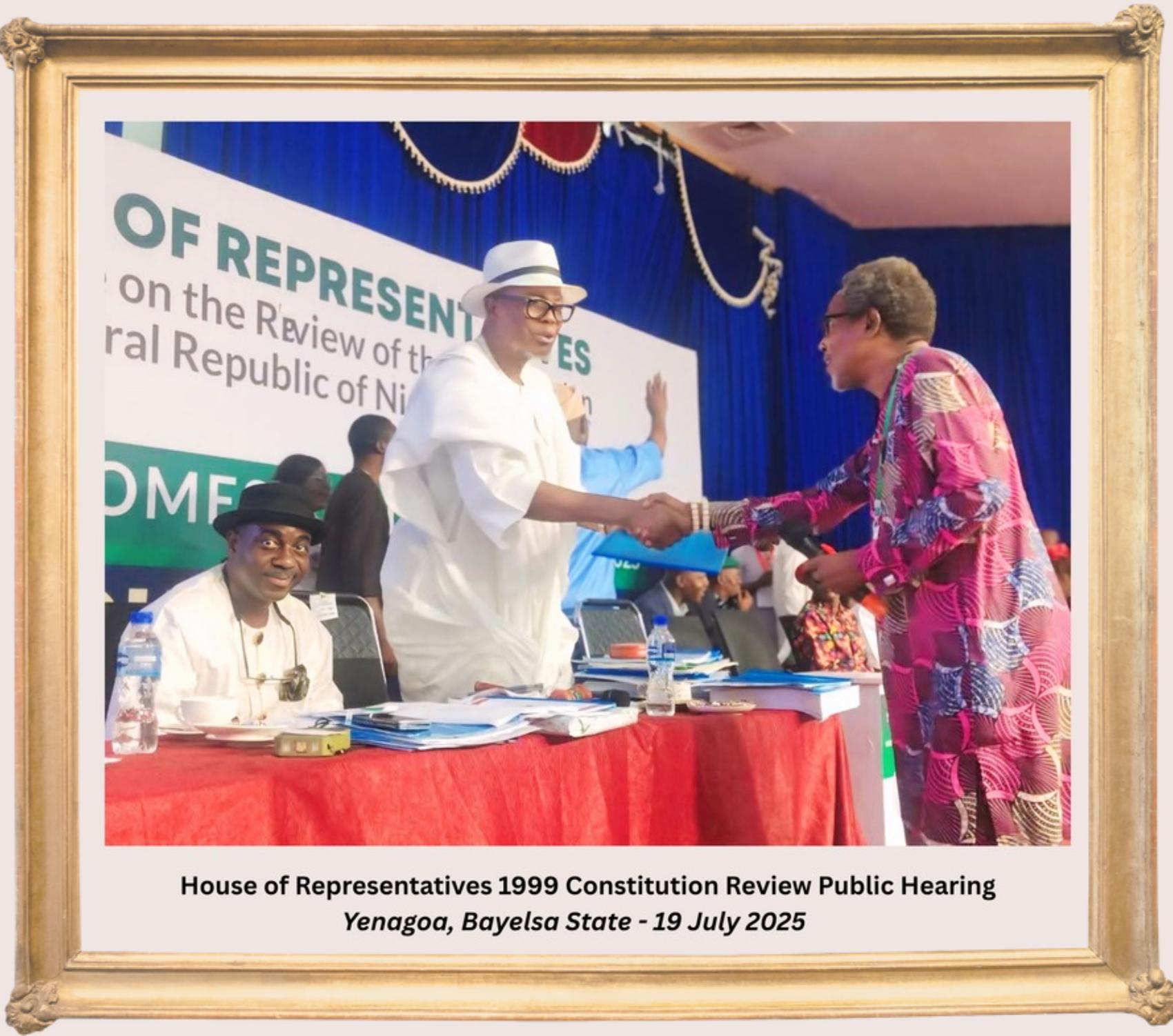
YENAGOA — The long-standing demand by the Engenni-speaking Ijaw people of Rivers State to be incorporated into Bayelsa State gained renewed momentum on Saturday, July 19, 2025, as representatives of the community made a passionate presentation before the House of Representatives Committee on the Review of the 1999 Constitution during a public hearing held in Yenagoa, the Bayelsa State capital.
The delegation, led by prominent traditional and community leaders, was headlined by Chief Eniata Abieba, who eloquently articulated the historical, cultural, geographical, and developmental reasons behind the Engenni people’s consistent demand to be included in Bayelsa State. According to Abieba, the Engenni people share deep ancestral, linguistic, and socio-cultural ties with the Ijaw clans in Bayelsa, particularly those in Yenagoa and its environs.
“The Engenni people are not strangers to Bayelsa,” Chief Abieba stated. “We are Ijaw people. Our dialect is closely related to that of Epie, Atissa, and Zarama. Our lands share a contiguous boundary with Bayelsa, and many of our communities have already been swallowed up by the expanding Yenagoa urban space. It is only just and fair that we be allowed to formally become part of Bayelsa State where our cultural heritage can be preserved and our people can access development more easily.”
Responding to the presentation, the Chairman of the Committee and respected lawmaker, Professor Julius Ihonvbere, commended the Engenni delegation for their clarity and peaceful advocacy. He assured them that their concerns and demands would be thoroughly reviewed and given due attention in the course of the constitutional amendment process.
“We thank you for this well-articulated submission,” Professor Ihonvbere said. “Every Nigerian community has the right to express its desires within the framework of the law. As a Committee, we are committed to fairness and inclusivity. Your position will be documented and given the seriousness it deserves.”
However, the road to Saturday’s presentation was not without its own political intrigue and procedural hurdles. Initially, the Engenni delegation had been slated to make their presentation at the Calabar Centre — the designated venue for Rivers, Akwa Ibom and Cross River States — a development that triggered confusion and protest from the group, who maintained that their interest and concerns were better addressed in Yenagoa, given the cultural and geographic context of their agitation.
“We were bewildered when we were told to go to Calabar,” one of the elders in the delegation confided. “How could we, an Ijaw people with historical roots and cultural alignment with Bayelsa, be redirected to a centre that has no bearing on our cause? We insisted on presenting our case in Yenagoa, and we’re grateful that common sense eventually prevailed.”
The Engenni people have long expressed opposition to their perceived inclusion in the proposed Orashi State — an idea gaining traction in some quarters, which would reportedly include Ahoada West (where Engenni is located), Ahoada East, Abua-Odual, Ogba-Egbema-Ndoni in Rivers State, and parts of Imo State.
They argued that the creation of such a state, which would likely fall under Nigeria’s South-East geopolitical zone and be dominated by the Igbo ethnic group, would effectively erase their Ijaw identity, placing them under the political and cultural dominance of an entirely different ethnic bloc.
“If we are forced into Orashi State, we will be politically and culturally displaced,” Chief Abieba warned. “We want to be with our Ijaw brothers and sisters. Our demand to join Bayelsa State is about preserving our language, our culture, and ensuring sustainable development for our people.”
The Engenni position was met with empathy by other Ijaw communities and traditional rulers present at the public hearing, many of whom expressed solidarity with the struggle and called on the federal authorities to respect the wishes of the people.
The public hearing is part of an ongoing nationwide exercise by the National Assembly to review the 1999 Constitution, with particular focus on issues of state creation, resource control, restructuring, and devolution of powers. The exercise has reignited calls from various ethnic nationalities seeking political reconfiguration to address long-standing grievances.
As the country continues to explore ways to strengthen its federal structure, the Engenni people remain steadfast in their pursuit to be officially recognised as part of Bayelsa State — a move they believe will mark a historic correction of past injustices and lay the foundation for inclusive development.
“We are not asking for too much,” Chief Abieba concluded. “We are only asking to return home.”
About Author

