

Constitutional Review: South-South States Push for Fiscal Federalism, Resource Control, State Police, and More

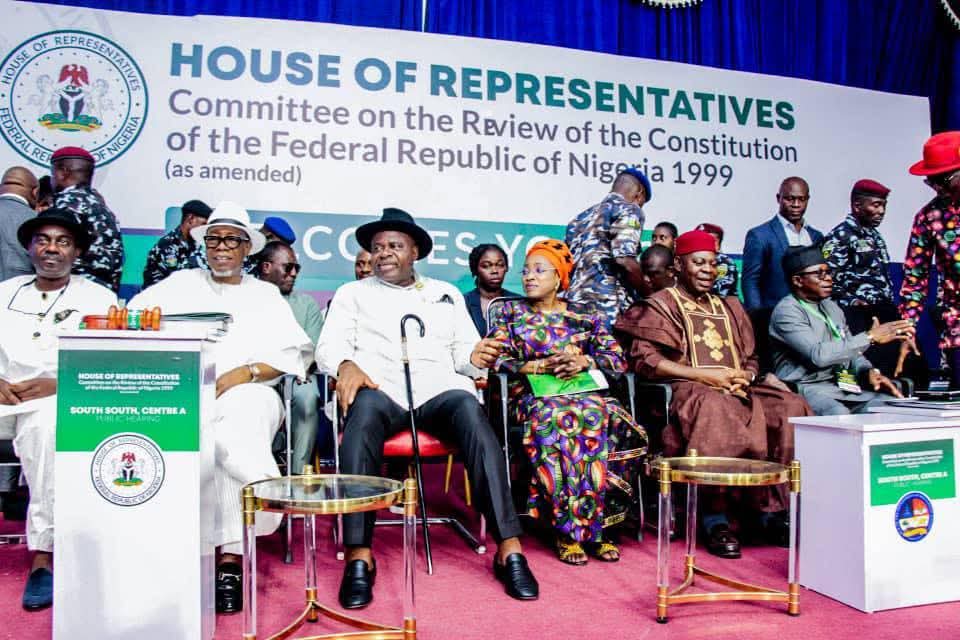
Calls for fiscal federalism, resource control, devolution of powers to federating units, an upward review of the derivation formula, the establishment of state police, and the right of states to create local government areas were dominant themes at the South-South Public Hearing on the Review of the 1999 Constitution (as amended), held in Yenagoa, Bayelsa State.
The public hearing, convened by the House of Representatives Committee on the Review of the 1999 Constitution (South-South Centre A), brought together stakeholders from Bayelsa, Delta, and Edo States—including state officials, ethnic nationalities, traditional rulers, civil society groups, women’s organisations, and youth bodies. The event took place at the Chief DSP Alamieyeseigha Memorial Banquet Hall.
Chairman of the committee and House Leader, Professor Julius Ihonvbere, stated that the objective of the exercise was to harvest the collective views and aspirations of the people of the South-South region and formally transmit them to the Tenth National Assembly for consideration in the ongoing constitutional review process.
In his remarks, Bayelsa State Governor, Senator Douye Diri, emphasized the need for the constitutional review to address long-standing injustices and structural imbalances affecting the Niger Delta region. He advocated strongly for fiscal federalism, increased resource control, and the transfer of power to states—including the right to create and fund local government areas.
Governor Diri said, “The constitutional review is a chance to right the wrongs of the past. The people of the Niger Delta continue to suffer environmental degradation and economic marginalization despite contributing significantly to the nation’s wealth. We must decentralize power and give states more autonomy to manage their affairs.”
In a similar vein, Delta State Governor, Rt. Hon. Sheriff Oborevwori—represented by Deputy Governor Sir Monday Onyeme—called for full local government autonomy and an upward review of the 13% derivation principle. He stressed that states should have control over their resources and the revenue they generate.
Edo State’s position, presented by the Attorney General and Commissioner for Justice, Dr. Samson Osagie, on behalf of Governor Monday Okpebholo, supported robust legislative, judicial, and electoral reforms. These included the adoption of electronic transmission of election results and the establishment of state police to enhance security. However, the Edo delegation opposed the proposed excision of any part of the state for the creation of a new state—a position that sparked vocal opposition from members of the Ijaw National Congress present at the hearing.
Dr. Osagie noted, “While we support greater autonomy and reforms that deepen democratic governance, Edo State will not endorse the division of its territory under any guise. Our position is rooted in the need to preserve our territorial integrity and communal harmony.”
The hearing attracted a massive turnout, with various stakeholders presenting memoranda and making passionate appeals for constitutional amendments that reflect the aspirations of the South-South people. The sheer volume of attendees occasionally posed logistical and security challenges, as security operatives worked to maintain order.
Traditional rulers, women’s coalitions, youth groups, professional bodies, and socio-political organisations all took turns to present position papers. Many reiterated long-standing grievances and emphasized the urgent need for constitutional provisions that promote equity, justice, and development across the federating units.
As the House Committee continues its zonal public hearings nationwide, stakeholders in the South-South region hope that the voices heard in Yenagoa will not be ignored and that the review process will lead to a more inclusive, just, and balanced Nigerian federation.
About Author

