

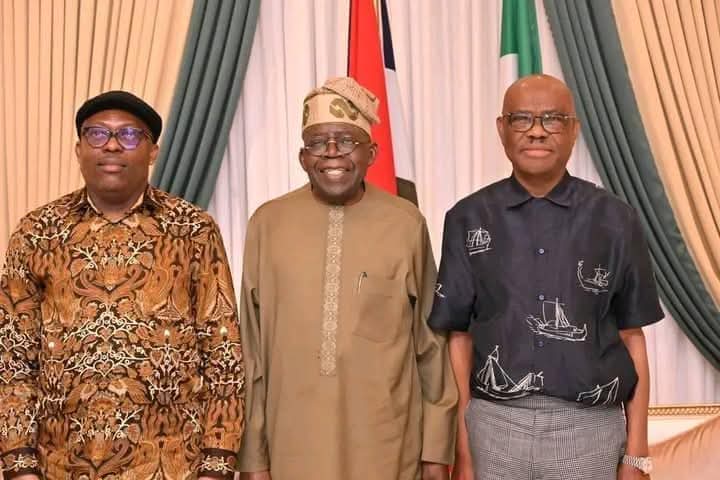
Mixed Reactions Trail Fubara–Wike Reconciliation as Tinubu Brokers Peace Deal in Aso Rock
Fubara Agrees to Complete Term Without Re-election Bid, Allows Wike to Nominate LG Chairmen – Presidency Sources

By Our Correspondent
Abuja – The political crisis rocking Rivers State may have reached a turning point following a high-level peace meeting on Thursday night, June 27, 2025, at the Aso Rock Presidential Villa, Abuja, where President Bola Ahmed Tinubu brokered a reconciliation between the suspended governor of Rivers State, Siminalayi Fubara, and his estranged political godfather, Nyesom Wike, who currently serves as the Minister of the Federal Capital Territory.
The closed-door meeting, which also had in attendance the suspended Speaker of the Rivers State House of Assembly, Rt. Hon. Martin Amaewhule, and some pro-Wike lawmakers, is reportedly the culmination of weeks of behind-the-scenes negotiations to end the prolonged political impasse in the state.
While the truce has been hailed in some quarters as a breakthrough for peace and governance in Rivers, others—particularly supporters of Governor Fubara—have expressed dissatisfaction, describing the outcome as a political capitulation and a compromise of democratic principles.
Deal Terms Spark Controversy
Multiple sources within the Presidency who are privy to the details of the agreement revealed that Fubara pledged not to seek re-election in the 2027 gubernatorial polls as part of the peace deal. One insider described the clause as the “main demand” by Wike’s camp and a condition that the President insisted upon to guarantee lasting peace.
> “It was one of the issues raised. In fact, it was the main issue. He agreed to conclude his tenure in peace and leave the stage after that,” a source said.
Another source added, “Yes, they reached an agreement yesternight (Thursday). The goal is for peace to return to Rivers State. But I think Fubara got the shorter end of the stick.”
In a further concession, Governor Fubara reportedly agreed to allow the Minister to nominate all the chairpersons for the 23 Local Government Areas in the forthcoming council elections.
Wike, Fubara Speak on Peace
Speaking to journalists after the meeting, Wike expressed optimism that the crisis had been firmly resolved and said that both sides had decided to sheath their swords in the interest of the state.
> “We are members of the same political family,” Wike stated. “Just like humans, you have a disagreement, and then you also have time to settle your disagreement. That has been finally concluded today, and we have come to report to Mr. President. So for me, everything is over.”
Governor Fubara, who had been at loggerheads with his predecessor since assuming office in May 2023, also confirmed the truce, attributing it to divine intervention. He pledged total commitment to preserving the unity and peace achieved during the meeting.
> “This is a turning point for Rivers State,” Fubara said. “It is the will of God, and I will play my part in ensuring the full implementation of this agreement for the benefit of our people.”
A Crisis Rooted in Power Struggles
The rift between Wike and Fubara had been one of Nigeria’s most publicized political conflicts in recent times. It began just weeks after Fubara assumed office, despite Wike being instrumental in his emergence as governor under the platform of the Peoples Democratic Party (PDP).
The tensions escalated in October 2023, when the Rivers State House of Assembly, largely loyal to Wike, commenced impeachment proceedings against Fubara. In response, Fubara ordered the demolition of the Assembly complex shortly after a suspicious fire incident and relocated the legislative sitting to a makeshift location—a move that further deepened the schism.
The resulting crisis led to a divided governance structure, public protests, and accusations of executive overreach. In December 2023, President Tinubu made an initial intervention, brokering a tentative peace accord in which Fubara conceded key appointments to Wike’s loyalists. However, the truce was short-lived as hostilities soon resumed behind the scenes.
Supporters Divided, Analysts Weigh In
Thursday’s resolution has drawn mixed reactions across the political spectrum in Rivers State. While some supporters of the governor have welcomed the truce as a much-needed return to stability, others see it as a political subjugation of Fubara’s mandate.
Political analyst Dr. Tonte Amakiri described the development as “a victory for pragmatism, but a defeat for institutional independence.”
> “What we are witnessing is a textbook example of political godfatherism undermining constitutional governance,” Amakiri said. “If indeed the governor agreed not to seek re-election, it raises serious questions about democratic integrity.”
Meanwhile, civil society groups have called for transparency in implementing the deal, warning that any backsliding could reignite the crisis.
What Lies Ahead
With the fragile peace now in place, observers say the onus is on both camps to maintain the terms of the agreement and focus on governance. While President Tinubu’s role as mediator has been widely praised, the real test lies in whether the truce will hold in the turbulent Rivers political terrain.
As the state prepares for local government elections, all eyes will be on the dynamics between the governor, his estranged godfather, and the state assembly—a triangle that will shape the future of governance in Rivers State in the months to come.
About Author

